Tesamorelin: Targeted Growth Hormone-Releasing Factor (GHRF) Analogue & Pituitary Somatotroph Dynamics
“Tesamorelin (TH9507) is a stabilized 44-amino-acid synthetic analogue of human growth hormone-releasing factor (GHRF 1-44) modified with an N-terminal trans-3-hexenoyl group, investigated for physiological pulsatile GH release, hepatic IGF-1 synthesis, and visceral adipose tissue catabolism.”
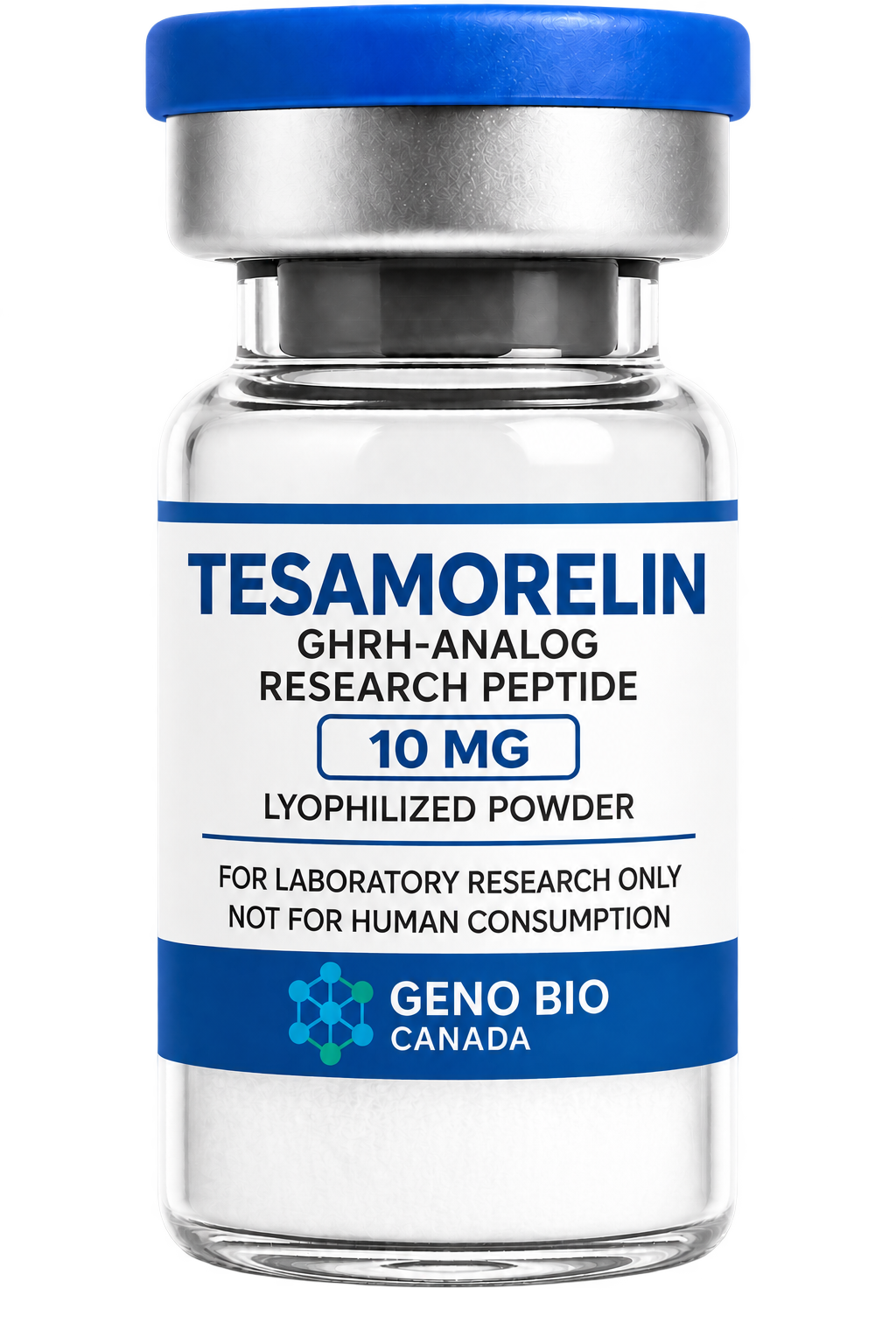
Legal & Laboratory Compliance Notice
FOR IN-VITRO LABORATORY RESEARCH ONLY: This scientific publication is provided strictly for academic and biochemical reference by certified researchers. Materials and compounds referenced are NOT for human consumption, veterinary use, drug manufacture, or direct clinical administration. Statements have not been evaluated by Health Canada or the FDA.
Scientific Research Overview
Abstract & Executive Summary
Tesamorelin (developmental code name TH9507) is a synthetic 44-amino-acid peptide analogue of human Growth Hormone-Releasing Hormone (GHRH / GHRF 1-44). While native human GHRH(1-44) is rapidly degraded in systemic circulation by Dipeptidyl Peptidase-4 (DPP-4) with a terminal half-life of less than 10 minutes, Tesamorelin is engineered with an N-terminal trans-3-hexenoic acid moiety that provides enzymatic resistance while retaining full bioactivity at the pituitary GHRH receptor.
Tesamorelin selectively stimulates anterior pituitary somatotrophs to synthesize and secrete growth hormone (GH) in a natural, pulsatile manner. Because it stimulates endogenous production rather than delivering exogenous recombinant human GH (rhGH), it preserves normal negative feedback regulation mediated by somatostatin and circulating IGF-1, avoiding supraphysiological continuous GH exposure and severe insulin resistance.
+----------------------------------------------------------------------------------------------------+
|                                    TESAMORELIN SOMATOTROPIC CASCADE                                |
+------------------------------------+----------------------------------+-----------------------------+
| Pituitary GHRHR Binding            | Pulsatile GH Secretion           | Target Tissue Actions       |
| - Gs-protein adenylyl cyclase      | - Retains somatostatin feedback  | - Hepatic IGF-1 generation  |
| - Intracellular cAMP/PKA activation| - Episodic physiological peaks   | - Hormone-Sensitive Lipase  |
| - L-type Ca2+ channel opening      | - Pit-1 de novo gene synthesis   | - Selective Visceral Fat Loss|
+------------------------------------+----------------------------------+-----------------------------+
Chemical Structure & Molecular Specifications
[trans-3-hexenoyl]-Tyr-Ala-Asp-Ala-Ile-Phe-Thr-Asn-Ser-Tyr-Arg-Lys-Val-Leu-Gly-Gln-Leu-Ser-Ala-Arg-Lys-Leu-Leu-Gln-Asp-Ile-Met-Ser-Arg-Gln-Gln-Gly-Glu-Ser-Asn-Gln-Glu-Arg-Gly-Ala-Arg-Ala-Arg-Leu-NH2Mechanism of Action
Tesamorelin operates through selective receptor binding and downstream intracellular signaling in anterior pituitary somatotrophs:
1. GHRH Receptor (GHRHR) Binding & cAMP/PKA Activation
Tesamorelin binds specifically to the GHRH receptor (a Gs-coupled GPCR) on the surface of pituitary somatotrophs:
2. Voltage-Gated Calcium Influx & Granule Exocytosis
Activated PKA phosphorylates voltage-dependent L-type Ca2+ channels, driving rapid extracellular calcium influx:
3. De Novo GH Gene Transcription (Pit-1 Activation)
PKA catalytic subunits translocate to the nucleus and phosphorylate the cAMP Response Element-Binding Protein (CREB):
4. Visceral Adipocyte Lipolysis & Hepatic IGF-1 Induction
Pulsatile GH released by Tesamorelin exerts targeted peripheral metabolic actions:
Key Study Highlights
N-Terminal Hexenoyl Stabilization
trans-3-hexenoyl modification confers robust resistance against DPP-4 degradation.
Pulsatile GH Release
Preserves natural somatotropic feedback loops without continuous receptor desensitization.
Visceral Adipose Mobilization
Selectively drives lipolysis in visceral fat depots, resolving abdominal lipodystrophy.
Pit-1 Transcription Factor Induction
Stimulates de novo growth hormone gene transcription in anterior pituitary cells.
Scientific FAQs
References
- Falutz J. et al (2007).Effects of tesamorelin on visceral adipose tissueN Engl J Med, 357(23):2359-2370
- Stanley T.L. et al (2019).Effects of tesamorelin on hepatic steatosis in NAFLDLancet HIV, 6(12):e821-e830
Procure Research Reference Materials
Access laboratory-grade reference compounds with verified batch HPLC purity reports and sterility documentation.
View Compound SpecificationsLiterature Inquiries
Have questions about the pre-clinical citations or chemical parameters detailed in this research? Connect with our analytical representatives.