MOTS-c: Mitochondrial-Encoded Peptide Regulation of Metabolic Homeostasis and AMPK Activation
“MOTS-c is a 16-amino-acid mitochondrial-derived peptide (MDP) encoded in the 12S rRNA gene that functions as a systemic endocrine messenger, promoting skeletal muscle GLUT4 glucose uptake, activating AMPK via folate-cycle modulation, and driving nuclear retrograde stress adaptation.”
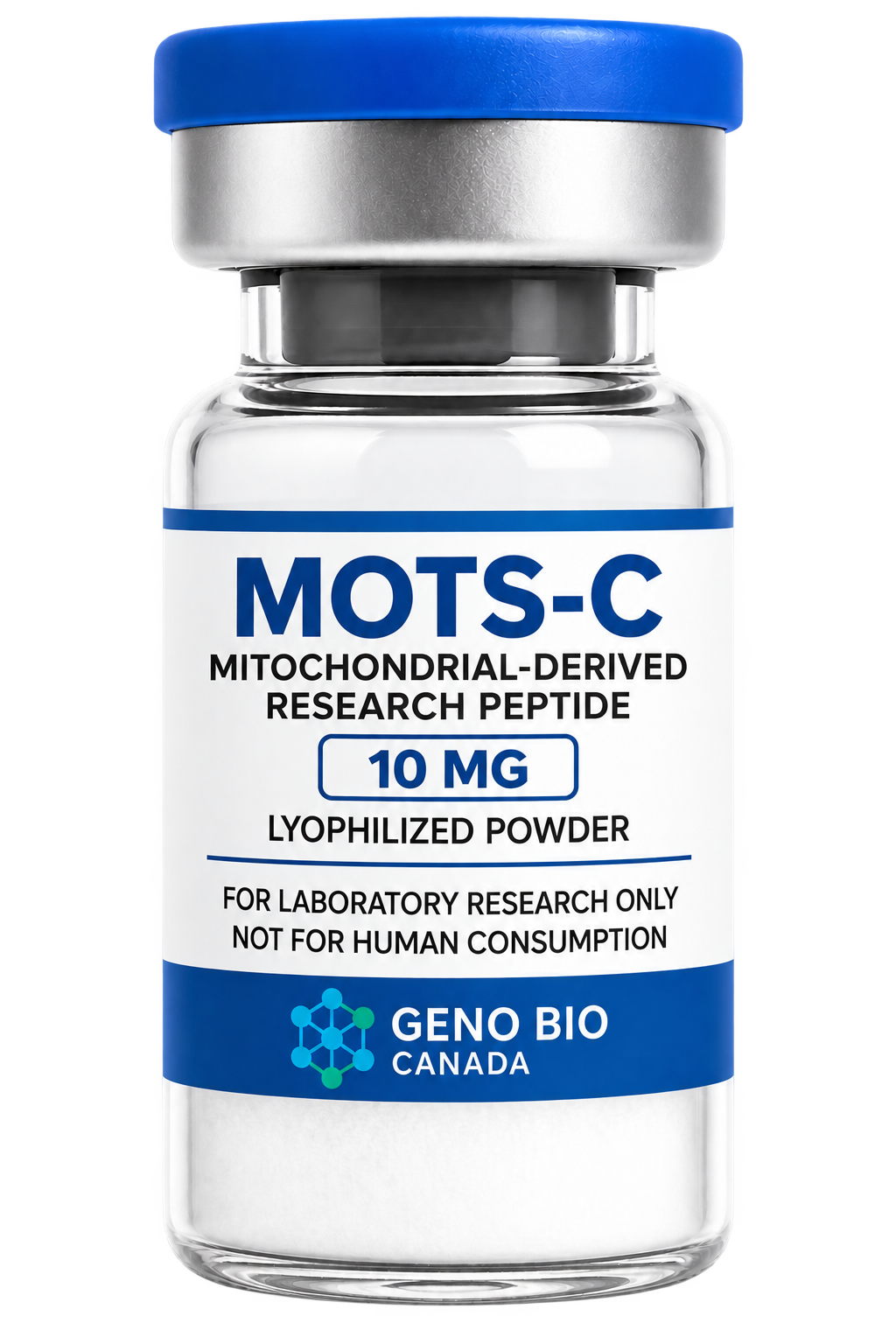
Legal & Laboratory Compliance Notice
FOR IN-VITRO LABORATORY RESEARCH ONLY: This scientific publication is provided strictly for academic and biochemical reference by certified researchers. Materials and compounds referenced are NOT for human consumption, veterinary use, drug manufacture, or direct clinical administration. Statements have not been evaluated by Health Canada or the FDA.
Scientific Research Overview
Abstract & Executive Summary
Mitochondria were historically regarded solely as the energetic powerhouses of eukaryotic cells. However, the identification of MOTS-c (Mitochondrial Open Reading Frame of the 12S rRNA Type-c) demonstrated that the 16,569-base-pair human mitochondrial genome encodes bioactive signaling peptides, known as Mitochondrial-Derived Peptides (MDPs).
Encoded by a short open reading frame (sORF) within the mitochondrial 12S ribosomal RNA locus, MOTS-c is translated in the cytoplasm and circulates systemically in human plasma. It functions as a classic peptide hormone, targeting skeletal muscle, liver, and adipose tissue to regulate energy homeostasis, enhance insulin-independent glucose clearance, and prevent diet-induced obesity.
+----------------------------------------------------------------------------------------------------+
|                                      MOTS-c MECHANISTIC CASCADE                                    |
+------------------------------------+----------------------------------+-----------------------------+
| Folate Cycle Interception          | AMPK Phosphorylation (Thr172)    | Nuclear Retrograde Action   |
| - Inhibits 5-MTHF synthesis        | - ACC inhibition (↑ Beta-Ox)     | - Translocates on stress    |
| - Causes de novo ZMP accumulation  | - GLUT4 plasma membrane insertion| - Binds NRF2 / ARE loci     |
| - Mimics AICAR energy depletion    | - Increases muscle glucose uptake| - Upregulates heat shock ptn|
+------------------------------------+----------------------------------+-----------------------------+
Chemical Structure & Sequence Architecture
Met-Arg-Trp-Gln-Glu-Met-Gly-Tyr-Ile-Phe-Tyr-Pro-Arg-Lys-Leu-ArgMRWQEMGYIFYPRKLRThe "Exercise Mimetic" Concept
In peer-reviewed animal trials published in Cell Metabolism and Nature Communications, MOTS-c administration demonstrated remarkable physiological overlap with physical endurance training:
Mechanism of Action
MOTS-c operates through a unique intracellular metabolic pathway distinct from classical peptide hormones:
1. Folate-Methionine Cycle Inhibition & AICAR Generation
MOTS-c targets the one-carbon folate-methionine metabolic pathway:
2. AMPK Activation & Lipid Oxidation Reprogramming
Elevated intracellular ZMP leads to the allosteric activation and phosphorylation of AMPK at Thr172 by upstream kinase LKB1:
3. GLUT4 Translocation in Skeletal Muscle
In skeletal myotubes, activated AMPK stimulates the phosphorylation of AS160 (Akt Substrate of 160 kDa):
4. Nuclear Retrograde Stress Translocation
Under conditions of metabolic or oxidative stress (e.g., glucose deprivation, heat shock):
Key Study Highlights
Mitochondrial Genome Origin
Endocrine peptide encoded within the mitochondrial 12S rRNA short open reading frame (sORF).
AMPK Phosphorylation
Drives AMPK Thr172 phosphorylation via intracellular ZMP/AICAR accumulation.
Insulin-Independent GLUT4 Uptake
Stimulates AS160 phosphorylation and GLUT4 plasma membrane translocation in myotubes.
Nuclear Retrograde Action
Translocates to the nucleus under stress to co-activate NRF2 antioxidant gene networks.
Scientific FAQs
References
- Lee C. et al (2015).The mitochondrial-derived peptide MOTS-c promotes metabolic homeostasis and reduces diet-induced obesityCell Metab, 21(3):443-454
- Reynolds J.C. et al (2021).MOTS-c is an exercise-induced mitochondrial-encoded regulator of age-dependent physical capacity and systemic metabolismNat Commun, 12(1):470
Procure Research Reference Materials
Access laboratory-grade reference compounds with verified batch HPLC purity reports and sterility documentation.
View Compound SpecificationsLiterature Inquiries
Have questions about the pre-clinical citations or chemical parameters detailed in this research? Connect with our analytical representatives.