Mechanisms of Retatrutide: The GIP, GLP-1, and Glucagon Receptor Triple Agonist
“Retatrutide (LY3437943) is an engineered single-peptide triple hormone receptor agonist targeting glucose-dependent insulinotropic polypeptide (GIP), glucagon-like peptide-1 (GLP-1), and glucagon (GCG) receptors, driving synergistic glycemic control, hepatic lipid clearance, and thermogenic energy expenditure in advanced metabolic research.”
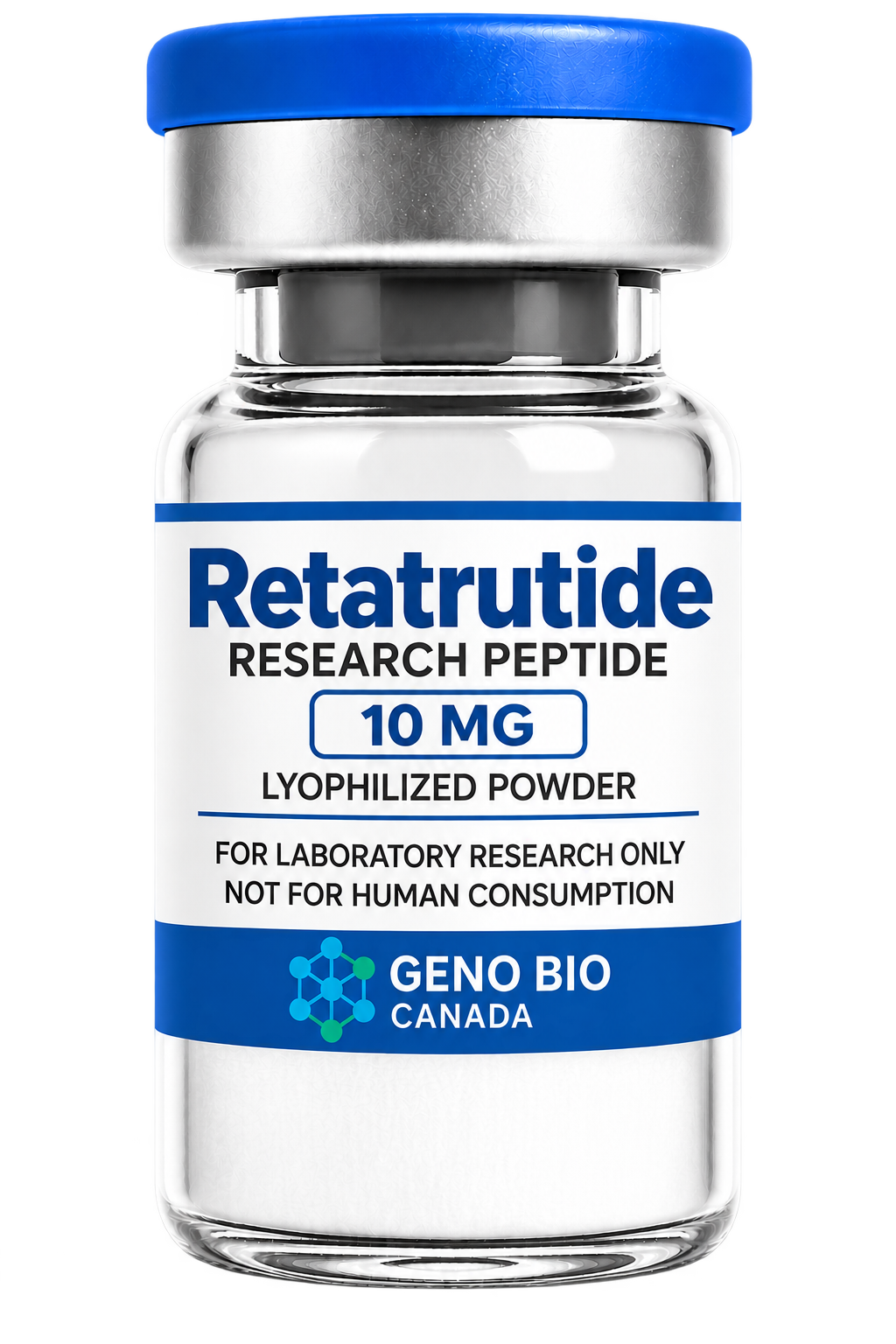
Legal & Laboratory Compliance Notice
FOR IN-VITRO LABORATORY RESEARCH ONLY: This scientific publication is provided strictly for academic and biochemical reference by certified researchers. Materials and compounds referenced are NOT for human consumption, veterinary use, drug manufacture, or direct clinical administration. Statements have not been evaluated by Health Canada or the FDA.
Scientific Research Overview
Abstract & Executive Summary
Retatrutide (developmental code name LY3437943) is an engineered 39-amino-acid synthetic unimolecular peptide designed to simultaneously engage and activate three distinct Class B secretin-family G-protein coupled receptors: the Glucose-Dependent Insulinotropic Polypeptide Receptor (GIPR), the Glucagon-Like Peptide-1 Receptor (GLP-1R), and the Glucagon Receptor (GCGR).
While first-generation incretin mimetics (e.g., Exenatide, Liraglutide, Semaglutide) targeted GLP-1R alone, and second-generation dual agonists (e.g., Tirzepatide) co-targeted GIPR and GLP-1R, Retatrutide represents the vanguard of third-generation "tri-agonists." The introduction of controlled glucagon receptor agonism recruits hepatic lipid oxidation pathways and systemic thermogenic energy expenditure without triggering pathological hyperglycemia, due to the potent counter-regulatory insulinotropic buffering of the GIP and GLP-1 arms.
+----------------------------------------------------------------------------------------------------+
|                                    RETATRUTIDE TRIPARTITE RECEPTOR AXIS                             |
+------------------------------------+----------------------------------+-----------------------------+
| GIP Receptor (GIPR)                | GLP-1 Receptor (GLP-1R)          | Glucagon Receptor (GCGR)    |
| - Potentiates insulin secretion    | - Inhibits postprandial glucagon | - Direct hepatic lipolysis  |
| - Suppresses metabolic nausea      | - Delays gastric motility        | - Accelerates β-oxidation   |
| - Promotes subcutaneous lipid sink | - Stimulates central satiety     | - Enhances resting EE       |
+------------------------------------+----------------------------------+-----------------------------+
Chemical Structure & Sequence Architecture
Retatrutide’s primary structure is derived from the native GIP backbone, strategically altered with non-proteinogenic amino acids and lipidation to optimize receptor binding kinetics and enzymatic longevity:
Tyr-Aib-Glu-Gly-Thr-Phe-Thr-Ser-Asp-Tyr-Ser-Ile-α-Me-Leu-Leu-Asp-Lys-Ile-Ala-Gln-Lys(AEEA-AEEA-γ-Glu-C20-diacid)-Ala-Phe-Val-Gln-Trp-Leu-Ile-Ala-Gly-Gly-Pro-Ser-Ser-Gly-Ala-Pro-Pro-Pro-Ser-NH21. Alpha-Aminoisobutyric Acid (Aib) at Position 2: Provides profound steric hindrance against Dipeptidyl Peptidase-4 (DPP-4) enzymatic cleavage.
2. Alpha-Methyl-Leucine (α-Me-Leu) at Position 13: Optimizes helical stability and enhances selectivity across GIP and GCG binding pockets.
3. C20 Diacid Fatty Acyl Chain at Lys20: Conjugated via a hydrophilic [2-(2-aminoethoxy)ethoxy]acetyl (AEEA) and gamma-glutamyl (γ-Glu) spacer, enabling high-affinity reversible binding to circulating human serum albumin. This extends the biological terminal elimination half-life to approximately 6 days in human pharmacokinetics.
Receptor Binding Affinities & Pharmacodynamics
In-vitro cell-based functional assays measuring cAMP accumulation reveal balanced, high-affinity tri-agonist potency:
| Target Receptor | Species | EC50 Potency (nM) | Relative Potency vs Native Ligand |
| :--- | :--- | :--- | :--- |
| GIPR | Human | 0.076 ± 0.012 nM | ~8.9-fold higher than native GIP |
| GLP-1R | Human | 0.77 ± 0.09 nM | ~0.3-fold of native GLP-1 |
| GCGR | Human | 0.58 ± 0.06 nM | ~0.4-fold of native Glucagon |
This tailored pharmacology ensures that GIPR agonism remains dominant, providing an intense insulinotropic and cytoprotective tone that completely neutralizes any potential hyperglycemic risk arising from GCGR-mediated hepatic glycogenolysis.
Comparative Pharmacology: Mono vs Dual vs Tri-Agonism
100% |                                                     [Retatrutide]
        |                                                     - GLP-1 (Satiety)
    75% |                              [Tirzepatide]          - GIP (Insulin/Adipose)
        |                              - GLP-1 (Satiety)      - GCG (Thermogenesis + Liver Fat)
    50% |       [Semaglutide]          - GIP (Insulin)
        |       - GLP-1 (Satiety)
     0% +---------------------------------------------------------------------------->
             First Generation           Second Generation          Third Generation
Mechanism of Action
Retatrutide coordinates its physiological actions across three discrete receptor signaling cascades in the brain, liver, pancreas, and adipose tissue.
1. Pancreatic β-Cell Potentiation (GIPR & GLP-1R Synergy)
Both GIPR and GLP-1R are Gs-protein coupled receptors expressed on the plasma membrane of pancreatic beta-cells.
2. Hypothalamic Appetite Suppression & Satiety Circuits (GLP-1R & GIPR)
Retatrutide penetrates the semi-permeable blood-brain barrier at the median eminence to act upon the Arcuate Nucleus (ARC) and the Nucleus of the Solitary Tract (NTS):
3. Hepatic Fatty Acid β-Oxidation & Lipolysis (GCGR Activation)
The glucagon receptor component of Retatrutide acts directly upon hepatocytes:
4. Adipose Tissue Browning & Non-Shivering Thermogenesis
GCGR agonism stimulates sympathetic outflow to adipose depots while directly engaging GCGRs expressed on brown and beige adipocytes:
Key Study Highlights
Triple GPCR Co-Agonism
Simultaneously engages GIP, GLP-1, and GCGR pathways with balanced nanomolar potency.
Hepatic Beta-Oxidation
Directly activates hepatic glucagon receptors to mobilize liver triglycerides and reverse steatosis.
Mitochondrial Thermogenesis
Elevates resting metabolic energy consumption (RMR) via UCP-1 upregulation in brown adipose tissue.
DPP-4 Resistance & Albumin Binding
Aib substitution and C20 diacid fatty chain confer an extended ~6-day in-vivo pharmacokinetic half-life.
Scientific FAQs
References
- Jastreboff A.M. et al (2023).Triple-Hormone-Receptor Agonist LY3437943 in Obesity — A Phase 2 TrialN Engl J Med, 389(6):514-526
- Coskun T. et al (2022).LY3437943, a novel GIP/GLP-1/glucagon triple receptor agonist with robust metabolic efficacyCell Metab, 34(9):1234-1247
- Finan B. et al (2020).GIP, GLP-1, and Glucagon Receptor Agonism for the Treatment of Type 2 Diabetes and ObesityDiabetes, 69(8):1588-1598
- Müller T.D. et al (2022).Glucagon-like peptide 1 (GLP-1) and beyond: multi-agonists in metabolic diseaseNat Rev Drug Discov, 21(3):201-223
Procure Research Reference Materials
Access laboratory-grade reference compounds with verified batch HPLC purity reports and sterility documentation.
View Compound SpecificationsLiterature Inquiries
Have questions about the pre-clinical citations or chemical parameters detailed in this research? Connect with our analytical representatives.