GHK-Cu Copper Peptide: Cellular Remodeling, Collagen Synthesis & Gene Expression
“GHK-Cu (Glycyl-L-Histidyl-L-Lysine Copper(II)) is a high-affinity copper-chelated tripeptide complex that resets human gene expression toward youthful repair, stimulating collagen and elastin synthesis, accelerating tissue remodeling, and quenching toxic lipid peroxidation.”
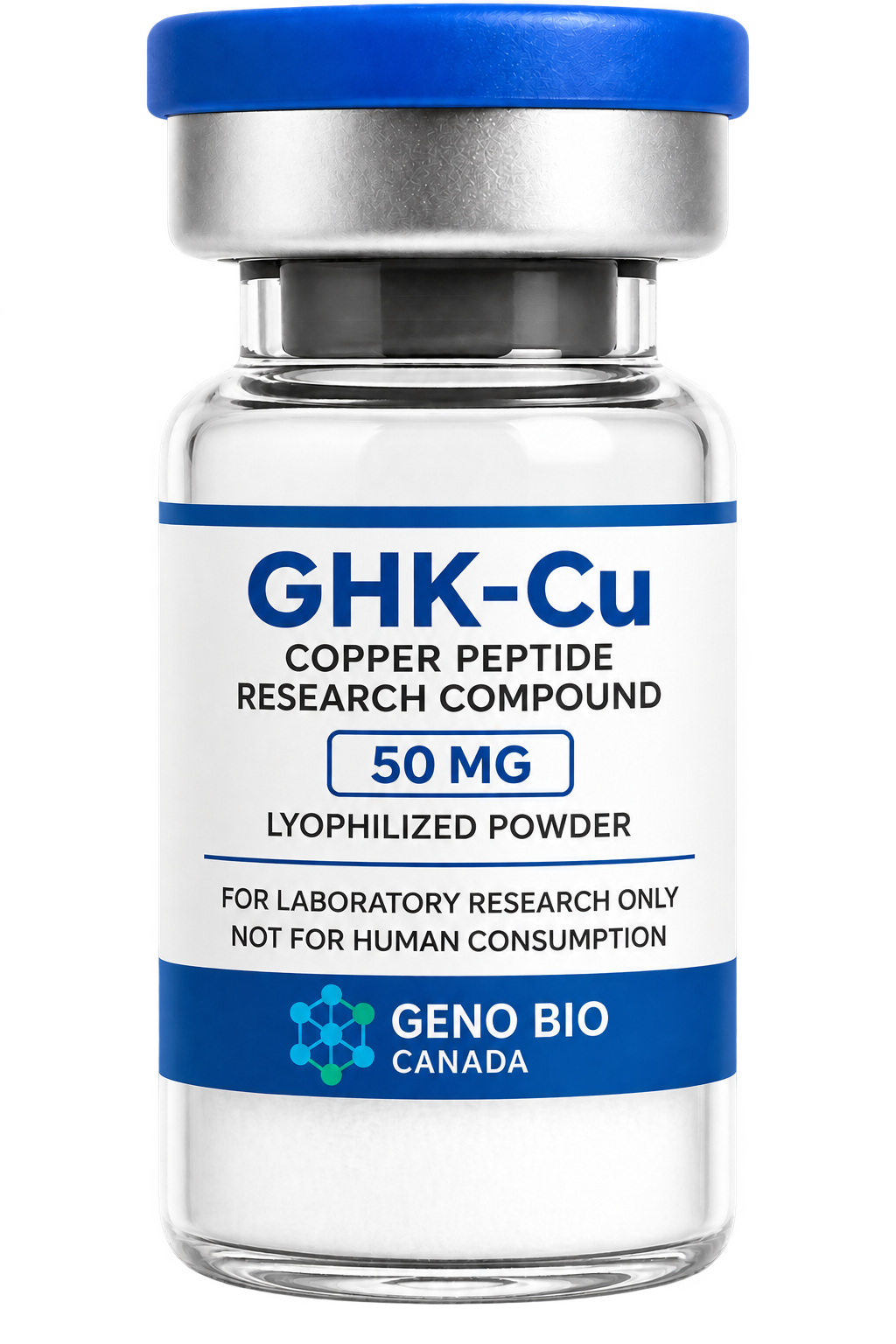
Legal & Laboratory Compliance Notice
FOR IN-VITRO LABORATORY RESEARCH ONLY: This scientific publication is provided strictly for academic and biochemical reference by certified researchers. Materials and compounds referenced are NOT for human consumption, veterinary use, drug manufacture, or direct clinical administration. Statements have not been evaluated by Health Canada or the FDA.
Scientific Research Overview
Abstract & Executive Summary
GHK-Cu (Glycyl-L-Histidyl-L-Lysine Copper(II)) is a naturally occurring tripeptide-copper complex found in human plasma, saliva, and urine. At age 20, the circulating plasma concentration of GHK is approximately 200 ng/mL (roughly 10^-7 M), but drops precipitously to ~80 ng/mL by age 60, directly mirroring the age-dependent decline in tissue regeneration and wound healing capacity.
GHK possesses an exceptionally high binding affinity for copper(II) ions (association constant log K = 16.4), allowing it to extract non-toxic Cu2+ from lower-affinity carriers (e.g., albumin) and safely transport it across cellular membranes to copper-dependent enzymes.
+----------------------------------------------------------------------------------------------------+
|                                      GHK-Cu MULTI-PATHWAY MODULATION                              |
+------------------------------------+----------------------------------+-----------------------------+
| Extracellular Matrix (ECM)         | Epigenomic Transcription         | Antioxidant / Anti-Fibrotic |
| - Type I, III, IV Collagen synthesis| - Upregulates 4,000+ repair genes| - Superoxide Dismutase (SOD)|
| - Elastin & Glycosaminoglycans     | - Suppresses NF-κB, IL-6, TNF-α  | - Balances MMP-2/9 vs TIMPs |
| - Lysyl Oxidase cross-linking      | - Restores stem cell pluripotency| - Quenches lipid aldehydes  |
+------------------------------------+----------------------------------+-----------------------------+
Chemical Structure & Chelation Geometry
Gly-His-Lys(Cu2+)1. The amino terminal nitrogen of Glycine.
2. The amide deprotonated nitrogen of the Gly-His peptide bond.
3. The imidazole nitrogen of the Histidine side chain.
4. An oxygen atom from a water molecule or lysine carboxylate.
This specialized coordination prevents free copper redox cycling (Fenton reactions), completely avoiding the generation of toxic hydroxyl free radicals.
Broad Institute Connectivity Map Findings
In groundbreaking computational genomic studies conducted with the Broad Institute (MIT/Harvard) Connectivity Map, GHK was shown to induce a remarkable shift in human gene expression:
Mechanism of Action
GHK-Cu coordinates wound healing and tissue revitalization through multiple enzymatic and transcriptional pathways:
1. Copper Delivery to Lysyl Oxidase (LOX) & Matrix Cross-Linking
Copper is a mandatory cofactor for Lysyl Oxidase (LOX):
2. Fibroblast Secretion of Collagen & Glycosaminoglycans
In cultured human dermal fibroblasts, GHK-Cu significantly upregulates the synthesis of:
3. Balanced Matrix Metalloproteinase (MMP) Remodeling
Unlike uncoordinated growth factors that can induce fibrotic clumps, GHK-Cu maintains precise ECM remodeling:
4. Direct Free Radical Scavenging & Superoxide Dismutase (SOD)
GHK-Cu enhances endogenous antioxidant defenses:
Key Study Highlights
Epigenetic Transcriptome Reset
Modulates >4,000 human genes, upregulating DNA repair and downregulating pro-inflammatory cytokines.
Collagen & Elastin Fibrillogenesis
Delivers copper to lysyl oxidase, stimulating dense collagen Type I/III and GAG matrix synthesis.
Anti-Fibrotic Remodeling
Balances MMP-2/9 and TIMP-1/2 expression to eliminate damaged proteins without scarring.
Superoxide Dismutase (SOD) Support
Supplies catalytic copper to Cu/Zn SOD, neutralizing toxic cellular reactive oxygen species.
Scientific FAQs
References
- Pickart L. et al (2018).Regenerative and Protective Actions of the GHK-Cu Peptide in the Light of the New Gene DataInt J Mol Sci, 19(7):1987
- Badenhorst T. et al (2016).GHK Peptide as a Natural Modulator of Multiple Cellular Pathways in Skin RegenerationBiomed Res Int, 2016:4389025
- Pickart L. et al (2012).The human tripeptide GHK-Cu in prevention of oxidative stress and tissue injuryOxid Med Cell Longev, 2012:324832
Procure Research Reference Materials
Access laboratory-grade reference compounds with verified batch HPLC purity reports and sterility documentation.
View Compound SpecificationsLiterature Inquiries
Have questions about the pre-clinical citations or chemical parameters detailed in this research? Connect with our analytical representatives.